Guide Number and Manual Mode of Flash Units
Introduction
In the previous blog post, we saw that once we turn on the flash, various indicators and symbols appear on its display. We explained which of them refer to the flash power levels (stops) and the flash head zoom.
In this blog post, we will examine how a flash works in greater detail. We will begin with the concept of the Guide Number (GN), which helps us understand the light output of a flash and its relationship with distance and aperture.
We will then move on to the Manual Mode of the flash and see how we can manually adjust the flash power in order to control the amount of light that reaches the subject.
Flash Guide Number (GN)
The Guide Number (GN) is a numerical value that indicates the light output of a flash. It is equal to the product of the aperture and the distance between the flash and the subject:
GN = Aperture (f-number) × Distance
The Guide Number is expressed in units of length, either meters or feet.
The higher the GN, the greater the light output of the flash. However, it is important to clarify that a GN value is meaningful only when the conditions under which it was measured are specified, particularly:
ISO sensitivity — The GN increases as the ISO setting increases.
Flash head zoom setting — When the flash head is set to a longer focal length, the light beam becomes narrower and the available light is concentrated over a smaller area. As a result, the GN increases. In most modern flashes, the camera communicates the lens focal length to the flash, and the flash head automatically adjusts its zoom position accordingly. The GN specified in a flash's specifications usually refers to the maximum zoom setting of the flash head — for example, 200 mm.
Flash power setting — The maximum GN is normally specified when the flash is operating at full power.
Unit of measurement — It should be specified whether the GN is expressed in meters or feet.
The standard practice among manufacturers is to specify the Guide Number in meters, at ISO 100, with the flash head set to its maximum zoom position and the flash operating at full power.
For example, the Godox TT685, as well as the TT685 II, has a maximum Guide Number of 60 meters (197 feet) at ISO 100, when the flash head is set to the 200 mm zoom position and the flash is operated at full power.
What is its practical significance?
1. If we know the Guide Number (GN) of the flash and the distance between the flash and the subject, we can calculate the aperture required for a correct exposure:
Aperture (f-number) = GN ÷ Distance
Example
Suppose a flash has a Guide Number of 40 at ISO 100, and the subject is 5 meters away:
f-number = 40 ÷ 5 = f/8
Therefore, at ISO 100 and with the flash operating at full power (1/1), we would use f/8 for a correct exposure.
Now suppose that we do not want to use the flash at full power (1/1), but instead reduce its power by one stop, to 1/2 power. We now have one stop less light from the flash, so we need to compensate for this loss somewhere else.
We can open the aperture by one stop, from f/8 to f/5.6. The result is the same exposure.
This illustrates an important practical advantage of understanding the Guide Number: without taking a test shot, and with only a few calculations, we can determine a useful starting point for our camera and flash settings.
2. We can also calculate the maximum distance at which the flash can correctly expose a subject when we know the aperture we are using.
Distance = GN ÷ Aperture (f-number)
Example
Suppose a flash has a Guide Number of 40 at ISO 100, and we are using an aperture of f/4:
Distance = 40 ÷ 4 = 10 meters
Therefore, at ISO 100 and with the flash operating at full power, the flash could theoretically provide a correct exposure for a subject at a distance of up to 10 meters, when using an aperture of f/4.
Of course, this calculation assumes that the Guide Number was measured under the same conditions—particularly the flash-head zoom setting and flash power.
What the Guide Number Means in Practice
The Guide Number (GN) is a practical way of quickly determining basic flash and camera settings, giving us a useful starting point for achieving a correct exposure.
In practice, however, the final exposure can be affected by various factors, such as the distance between the flash and the subject, the use of a reflector or other light modifier, the position of the flash, and so on.
Nevertheless, the Guide Number allows us to quickly determine some initial settings for both the camera and the flash. We can then take a first shot, evaluate the result on the camera's display, and decide whether we are satisfied with it or whether some of the settings need to be adjusted.
In other words, the Guide Number is not necessarily the final answer for exposure. Instead, it provides a useful starting point, allowing us to begin with a calculated estimate rather than relying entirely on trial and error.
Flash Manual Mode
In Manual Mode (Manual or M), the photographer has full control over the flash output.
The basic steps are as follows:
Set the shutter speed, selecting the camera's flash sync speed or a slower shutter speed.
Select the ISO setting. It is usually preferable to start with a relatively low sensitivity, for example ISO 100–400, and adjust it according to the shooting conditions.
Select the desired flash power level. When full power is not necessary, it is generally preferable to avoid using full power (1/1). This helps conserve battery power and reduces the intensity of the flash reaching the subject. Lower power settings also generally allow faster recycling times and more consecutive shots.
Set the flash-head zoom (on models that offer this function). We can choose between:
Automatic zoom (A), where the camera communicates the lens focal length to the flash, and the flash head automatically adjusts its zoom accordingly.
Manual zoom (M), where the photographer selects a specific zoom value, which remains fixed regardless of any changes in the lens focal length.
Determine the distance between the flash and the subject.
Using the methodology described above and based on the flash's Guide Number (GN), calculate the required aperture as an initial estimate.
Take a test shot and examine the result on the camera's display. We can then decide whether we are satisfied with the result or whether some of the settings need to be adjusted.
The image below shows the Manual Mode (M) of a Godox TT685 flash. The flash power has been manually set to 1/128, while the flash-head zoom is set to Manual, with a manually selected value of 50 mm.
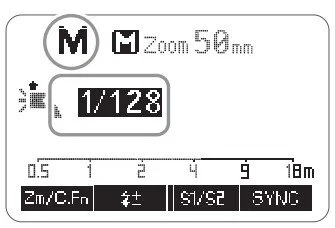
Manual Mode therefore gives the photographer predictability, consistency, and complete control over the lighting. It is an essential tool, particularly in portrait photography, studio photography, and generally in any situation where we want the lighting to remain consistent and repeatable from one shot to the next.
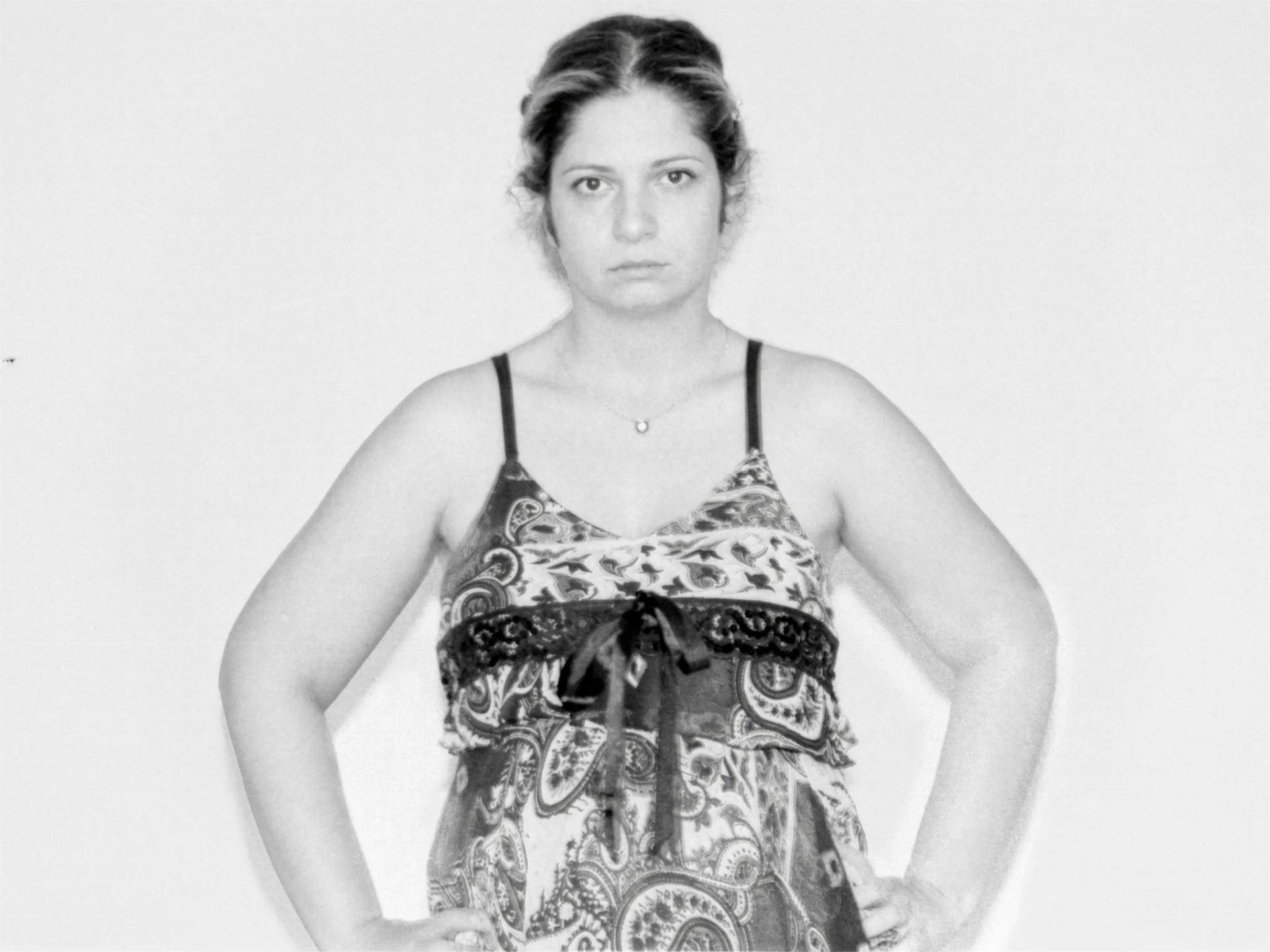
The photograph above was taken with a Chinon CE-4s analog camera from the early 1980s, using AgfaPhoto APX 100 B&W Negative film.
The shutter speed was set to the camera's flash sync speed. For this particular camera, the sync speed is 1/60 sec.
The ISO setting was straightforward: ISO 100, corresponding to the sensitivity of the film being used.
The flash, a Chinon Auto S380, operates at only one power level, namely full power (1/1).
The Chinon Auto S380 does not have a zooming flash head, and its automatic mode is not compatible with this particular camera. It was therefore used strictly in Manual Mode.
The photograph was taken with a 135 mm focal-length lens and, in order to achieve the desired framing, the distance from the subject was approximately 9 meters.
The flash has a Guide Number of GN 38 m at ISO 100. The flash has a fixed flash-head zoom.
Therefore, the aperture required for correct exposure can be calculated using the formula:
Aperture (f-number) = GN ÷ Distance
Aperture (f-number) = 38 ÷ 9 ≈ f/4
Therefore, with ISO 100, a shutter speed of 1/60 sec, a subject distance of 9 meters, and the flash operating at full power, the calculated aperture was f/4.
What makes this example particularly interesting is that, unlike modern digital photography, it was impossible to evaluate the image immediately after taking the photograph. To see the result, the film first had to be developed.