Flash Power Stops and Flash Head Zoom Settings
Introduction
In the previous blog, we saw that when using flash, we cannot always freely choose any shutter speed we want. Instead we need to set the camera to the flash sync speed or below.
Once we have set the camera to the sync speed, we mount the flash on the camera and switch it on. Various indicators and symbols appear on its display, which may initially seem unfamiliar and difficult to understand.
From this point on, we will begin examining the basic functions and settings of a flash, in order to understand what the various indicators mean and, most importantly, how we can use them in practice.
In this article, we will start with two of the most important concepts: flash power stops and flash head zoom. We will then discuss recycle time, as well as flash overheating, an especially important issue when taking consecutive shots at high power levels.
Flash Power Stops
Electronic flashes allow the controlled adjustment of flash output using a standardized method: power stops. The principle is similar to that of exposure stops used for aperture, shutter speed, and ISO sensitivity.
The power output of a flash can therefore be adjusted, depending on the model, from 1/1 (full power) to 1/2, 1/4, 1/8, 1/16, 1/32, 1/64, 1/128, and so on.
Each increase of one stop doubles the energy delivered by the flash, while each decrease of one stop halves it.
This method allows us to control flash power in harmony with changes in the other exposure parameters, such as aperture and ISO. In this way, we can compensate for these changes and achieve the desired exposure of the subject.
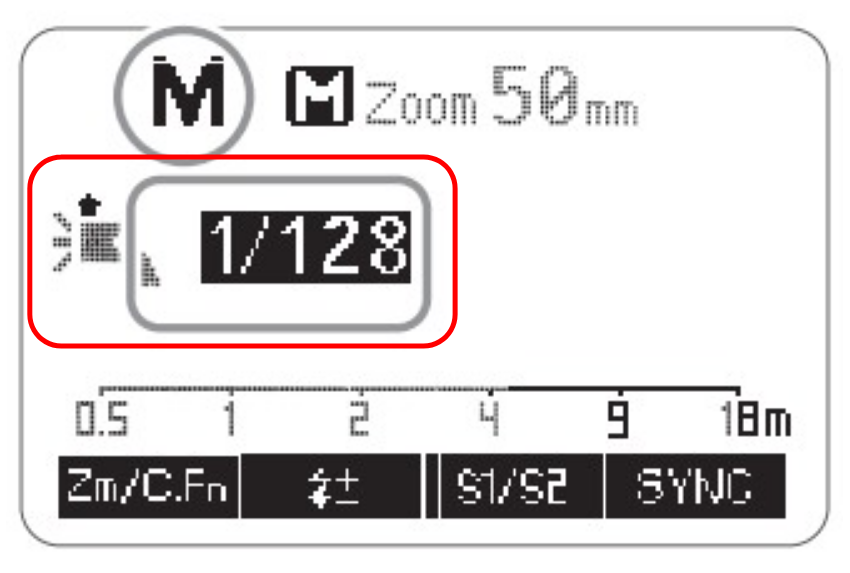
The image below shows the display of a Godox TT685 flash, with the power output set to 1/128, which is eight stops below full power.
Example
Let us assume that we have a metered exposure indicating an aperture of f/8 and a flash power setting of 1/4.
If we want to reduce the depth of field, we can open the aperture and select f/2.8. The change from f/8 to f/2.8 increases the exposure by 3 stops:
f/8 → f/5.6 → f/4 → f/2.8
To theoretically maintain the same flash exposure, we should reduce the flash power by 3 stops:
1/4 → 1/8 → 1/16 → 1/32
Therefore, with the new aperture setting of f/2.8, the corresponding flash power will be 1/32.
In this way, we can change the aperture for creative purposes, such as controlling depth of field, without theoretically changing the amount of light reaching the subject from the flash.
Flash Head Zoom
One of the fundamental characteristics of any lens is its focal length for prime lenses, or its range of focal lengths for zoom lenses. Among other things, focal length determines the angle of view that the lens can capture.
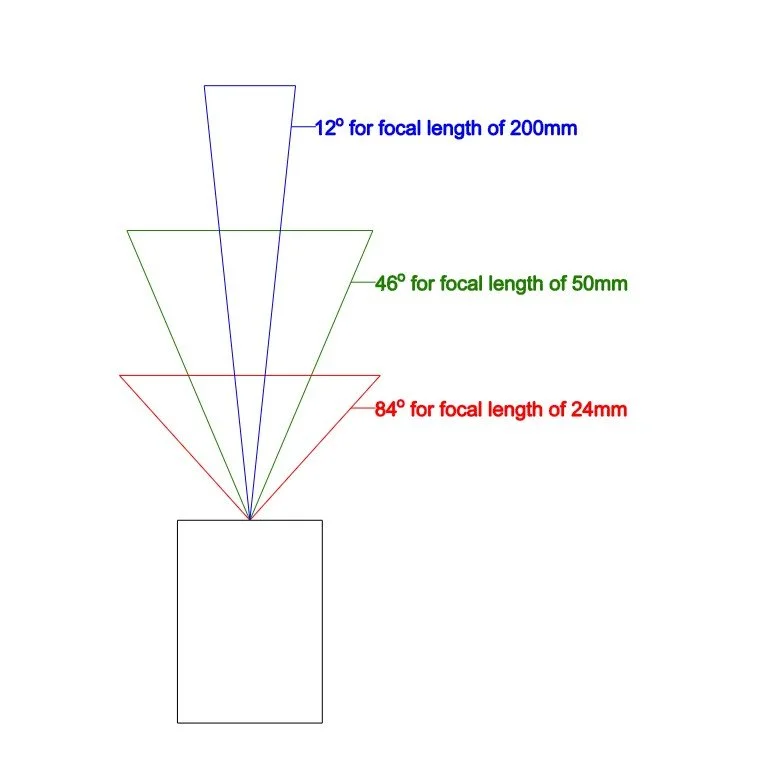
The diagram below illustrates the angle of view, in degrees, for 24mm, 50mm, and 200mm focal lengths on a full-frame sensor. As the focal length increases, the lens’s angle of view becomes narrower.
Many modern flashes feature a zoom head function, which adjusts the coverage of the light beam so that it corresponds as closely as possible to the angle of view of the lens. For this reason, the zoom setting of the flash head is displayed on the flash in mm, just like the focal length of the lens.
The flash head zoom function can generally be used in two ways:
• Automatic mode (A): The camera communicates the current focal length of the lens to the flash, and the flash automatically adjusts the position of its head accordingly. This mode is particularly convenient when using zoom lenses, as the flash head zoom changes automatically whenever we change the lens’s focal length.
• Manual mode (M): The user manually selects the desired flash head zoom setting. This value remains fixed, regardless of the lens’s focal length, until it is changed manually.
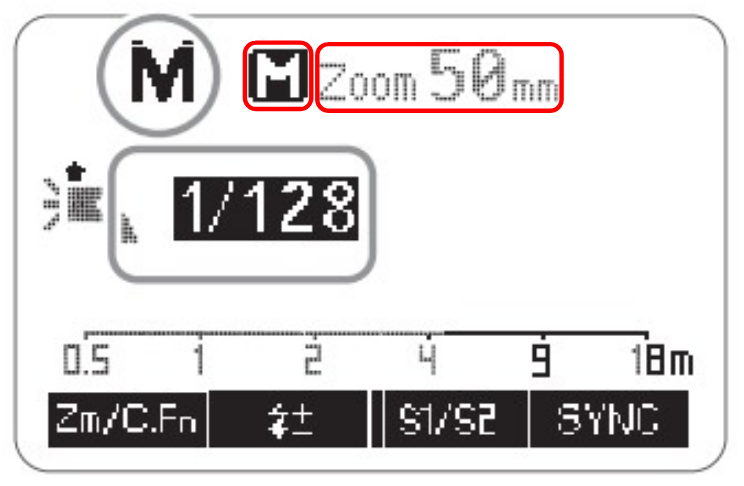
The image below shows the display of a Godox TT685, with manual mode (M) selected and the flash head zoom set to 50mm. At this setting, the flash provides a light beam coverage of approximately 46°.
When the lens is used at wide-angle focal lengths, the flash head is set to a lower zoom value, resulting in a wider light beam. Conversely, when longer focal lengths are used, the flash head moves to a higher zoom value, making the light beam narrower and more concentrated.
Therefore, for the same flash power setting, the same amount of light is distributed over a smaller area when a higher zoom value is used. As a result, the light intensity per unit area is greater than with a lower zoom value, where the same amount of light is distributed over a wider area.
Consequently, the maximum light intensity is achieved when the flash operates at full power (1/1) and the flash head is set to its maximum zoom value.
However, under these conditions, the light beam is also at its narrowest. If manual (M) mode is selected with the flash head zoom set to its maximum value while using a wide-angle focal length, dark areas may appear around the edges of the image. This may be undesirable in conventional photography, but it can also be used intentionally for more creative applications.
Flash Recycle Time and Overheating
Each time an electronic flash is fired in rapid succession, a certain amount of time is required between two consecutive flashes for its capacitor to recharge. This interval is known as the recycle time, and it varies from one flash model to another.
For every flash, however, the recycle time is longest when the flash is fired at full power. For example, on the Godox TT685, the recycle time at 1/1 power is approximately 2.6 seconds. Conversely, the recycle time is shortest when the flash is fired at its lowest power setting; on the Godox TT685, for example, the recycle time at 1/128 power is approximately 0.1 seconds.
Another disadvantage of operating a flash at full power is the thermal stress it generates. Each model allows a limited number of consecutive full-power flashes before its overheating protection circuit temporarily disables the flash to prevent damage. For example, the Godox TT685 allows approximately 30 consecutive flashes at 1/1 power, compared with approximately 1,000 flashes at 1/128 power, before its overheating protection is activated.
If this occurs, several minutes may be required for the flash to cool down to an operational temperature. In the case of the Godox TT685, the manufacturer specifies a cooling period of at least 10 minutes.
It is therefore easy to see why it is advantageous to avoid operating the flash at full power, especially when firing it repeatedly in rapid succession, such as when photographing an event.
One way to reduce the required flash power is to use a wider aperture on the lens—for example, f/4 instead of f/5.6—and/or a higher ISO sensitivity, such as ISO 400 instead of ISO 100.
For example, selecting ISO 400 instead of ISO 100 increases sensor sensitivity by 2 stops, allowing the flash power to be reduced by 2 stops, from 1/1 to 1/4.